Reaching the Destination: Using Student Work to Guide the Journey

(Part 3 of the “Recalculating” Series)

Haven’t read Part 1 or Part 2, be sure to check those out first.
Speaking as someone who is directionally challenged, and as I’ve shared before, I can get lost in a parking lot. I feel a genuine sense of accomplishment when I actually end up where I intended to go. That doesn’t happen by chance. It’s because I use my GPS to guide me. I’m certain, with its help, I could find my way to New York. In much the same way, when we use our standards to chart the course for learning and check in along the way, we give ourselves the chance to either recalculate or celebrate.

But just setting a destination isn’t enough. Along the way, I have to glance at the map, listen for turns, and sometimes reroute when I miss one. Teaching works the same way. Standards help us know where we’re headed, but it’s the lesson check-ins such as the effective questions, the short formative assessments, and the student work in front of us that tell us if learning is actually happening. When we take the time to look closely at that evidence, we can make decisions that keep students on the path toward mastery, rather than assuming they’ll find their own way there.

I’ve learned that if I don’t stop and check my direction, I’ll keep driving in the wrong direction with complete confidence. The same thing happens in classrooms. Teachers can teach their hearts out and still not be certain if the lesson was aligned to the rigor of the standard or if students are actually learning it. When you ask one or two students who know the answer, that is not confirmation they all know. That’s where formative checks for understanding come in. They’re like little landmarks along the way that help us see if students are actually getting there. It doesn’t take fancy tools or long tests. It simply requires a clear look at the work before us and an honest conversation about what it reveals. It’s important to also acknowledge those outcomes reflect our instruction. That’s the kind of intentional pause that helps teachers recalculate when needed and celebrate when learning sticks. That’s the kind of teaching that is steady, purposeful, and always headed in the right direction.

So, late-Lee, I’ve been thinking about this whole process. I struggle to understand where the disconnect is and why this seems to be such a challenge for some. We plan to teach the standards at the prescribed level, determine what success looks like, and design formative assessments that we can use to see if students are mastering the learning or identify where the gaps are that we need to address during and after we’ve delivered the planned lesson. Seems clear enough. Let’s now talk about reviewing the evidence. 

A Simple Way to Look at Student Work

Now, before anybody starts thinking this is one more thing to add to an already full plate ( I hear that often too.). Let me be clear: Looking at student work doesn’t have to be complicated. It just needs to be consistent. When we take a few minutes to pause and study what our students produced that day, we gather the kind of information that helps us teach smarter tomorrow.

I like to think of it as pulling over for a quick check instead of waiting until the end of the trip to find out we missed the turn miles back. The best teachers I know employ a simple routine that enables them to identify patterns in learning and make informed decisions about what comes next. Here’s a straightforward way to do that.

The Journey Through Learning Protocol

Step 1: Start with clarity

Review the learning target and success criteria. What did you expect students to know and show by the end of the lesson?

Step 2: Gather the evidence

Pull a small sample of student work from that day. It could be an exit ticket, a sticky note response, or even a quick reflection you captured in conversation.

Step 3: Sort and see

Lay out the work and look for patterns. Who clearly met the target? Who’s close? Who’s still off course? You don’t need a specific number or grade; you need a sense of where your class stands.

Step 4: Study a few samples

Choose one or two examples from each group and look a little closer. What do these pieces tell you about how students are thinking? What misunderstandings might be hiding in their responses?

Step 5: Plan the next move

Use what you found to decide what tomorrow needs. Perhaps some students are ready for the next challenge, while others require another approach. Either way, the goal is movement.

Step 6: Talk about it

Share what you learned with students. Let them see how their work guides your teaching. Ask them to reflect on what they can do next. Learning is more powerful when everyone knows the destination and how close they are to reaching it.

This protocol was adapted from the “Student Work Analysis Protocol” by the Rhode Island Department of Education and the National Center for the Improvement of Educational Assessment.

Reaching the Destination

When I finally pull into the location after a long ride, there’s a quiet satisfaction in knowing I made it. I might’ve had to circle the block once or twice, but I got there. Teaching is no different. The road to learning is rarely straight, and the best teachers aren’t the ones who never miss a turn. They’re the ones who notice when they have and make the adjustment.

Formative assessments are what help us do that. They let us see if students truly arrived where the lesson was meant to take them. When we slow down long enough to look at their work, we’re not just checking for completion. We’re checking for understanding, growth, and readiness for what’s next.

So whether you’re recalculating, celebrating, or somewhere in between, remember this: every stop along the way tells you something about the journey. Keep your eyes on the map, your heart in the work, and your hands steady on the wheel. That’s the Late-Lee way to reach your destination: one thoughtful turn at a time.

Aligning Assessment with Intention

Part 2 of 3: The Learning Journey Series

Haven’t read Part 1? Check it out: Setting the Route – Why Clarity Matters 

When we’re clear about what students should know, understand, and do, the next step is knowing whether they’re actually getting there. Too often, we rely on long, end-of-unit tests to tell us who didn’t get it after it’s too late to adjust. However, when done with intention, formative assessment turns our daily lessons into feedback loops for both teacher and student.

Think of it like driving with your GPS on. You don’t wait until the end of the trip to find out you took a wrong turn. You need those real-time updates that reroute you before you end up miles off course. That’s precisely what formative checks do.

During collaborative planning in schools, I often notice something missing. Teams unpack standards, design lessons, and choose activities, but there’s rarely deep discussion about how they’ll check for understanding. The “check” often becomes an afterthought, added in the moment rather than planned with purpose. But without it, we’re guessing instead of knowing.

I remember sitting in a classroom once where a teacher asked her students a question no one could answer. The room went completely silent. After a long pause, she said, “You learned this,” and moved on. Here’s the fallacy in that statement: teaching and learning aren’t the same thing. She may have presented the concept and given students practice, but the quiet at that moment was the data. It was a signal that understanding hadn’t yet taken hold. That silence should have prompted a pause and a reteach, not a dismissal.

When planning formative checks, we allow ourselves to notice those moments and respond. Assessment is what gives standards meaning. It takes the expectation off the page and makes learning visible. A quick exit ticket, sticky-note sort, or one-question reflection can give you far more usable data than a 25-question quiz. The key is alignment. If the learning target says, “I can identify the theme of a story,” then the check should ask students to do precisely that, not summarize, not list details, but identify and explain the theme.

When assessments are designed with the learning target in mind, they do more than measure, they clarify what success looks like. The lesson assessment helps identify the success criteria. Students and teachers use those criteria to gauge where they are in the progression of learning. It becomes a shared roadmap. Teachers see which parts of the target are solid and which need more support. Students gain language to describe their progress: “I can identify the theme, but I still need help explaining how the details support it.” That clarity turns assessment into a learning tool instead of a judgment.

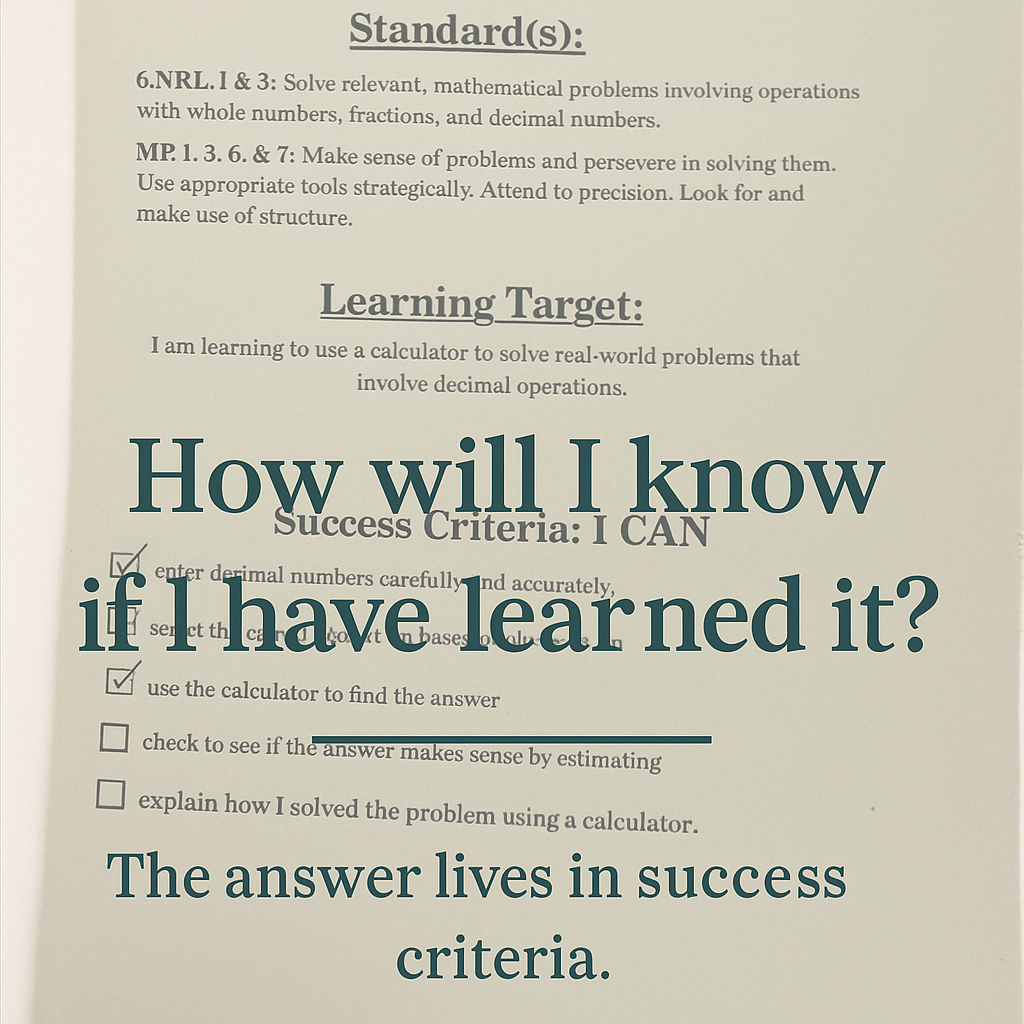
Every student should be able to answer a straightforward question: “How will I know if I have learned it?” Too often, they can’t because the criteria for success haven’t been clearly communicated or modeled. When success criteria are visible and discussed, students can take ownership of their learning instead of waiting to be told whether they “got it.”

It’s interesting that we still struggle to define success in clear, student-friendly terms, even though the concept isn’t new. Success criteria have been part of educational thinking for decades. In fact, Paul Harmon wrote in 1968 that success criteria are necessary for any performance objective associated with student outcomes. Yet, all these years later, many planning conversations still skip this step.

Maybe it’s because we assume it’s implied. Or perhaps it feels easier to talk about activities than outcomes. But when teachers and students know exactly what success looks like, instruction becomes focused, feedback becomes meaningful, and assessment becomes purposeful.

Long, unfocused assessments blur what we’re really trying to see. They mix multiple skills, confuse the data, and make it hard to know what to reteach. In contrast, short, targeted checks help you act fast. They show who’s ready to move on, who needs support, and which part of the lesson needs another pass.

Formative assessments aren’t just for grading; they’re for guiding. When aligned with intention, they don’t just measure learning, they drive it.

Leadership Reflection

When I visit classrooms or sit in planning meetings, do I hear evidence that teachers and students both understand what success looks like?

How often do our assessments serve as a mirror for learning rather than a measure of teaching?

Recalculating: A Series on Finding Direction in Teaching and Learning

Part 1: Setting the Route — Why Clarity Matters

I’m that girl! I’m the one who gets lost in a parking lot. So, when I get in my car, I don’t just start driving and hope I end up where I want to go. I plug in the destination, and my GPS maps the route. Along the way, I might add a few stops for gas or coffee, but I always know where I’m headed, or the general direction 😊. My destination is clear. 

Teaching works the same way. Our standards are the destination. They tell us where student learning should end up, what students should know, understand, and be able to do. Learning targets are the stops along the route. They are part of the trajectory that leads to a successful trip. They help both teachers and students see where the current lesson fits in the journey.

Still, there’s an ongoing debate about whether or not we should post learning targets. Teachers say they’re for principals. Principals say they’re for districts. But who’s advocating for the students?

Students need to know what they’re learning on any given day, and how it connects to where they’ve been and where they’re going next. I don’t get in my car and drive mindlessly. I have a clear path. Why wouldn’t we want learning to be the same? We should want it to be clear for all involved. Students also need to know what mastery looks like, so they can recognize when they’re getting closer. We will dive deeper into that in another post. 

Late-Lee, I’ve noticed posts by a principal that many teachers follow online saying what many want to hear: “Don’t post them.” Now, I’ll admit, I’d love to spar with him a bit. He says you can walk into a classroom and tell if students are getting quality instruction. I won’t argue that intense instruction is visible. However, as a former administrator myself and a certified school improvement specialist, I must ask: how does he know if the task or lesson is aligned with the state standard? Alignment isn’t always apparent on the surface. You must understand what students are expected to learn, not just what they’re doing, to determine effectiveness. I could elect to teach a group of 6th graders about plant and animal cells and keep the instruction at a fundamental level, focusing on identification. An administrator could walk in, see students looking at slides, drawing pictures, etc, and think, “Yeah, they are getting it.” However, if the level they should be reaching is much deeper, such as understanding their function, then it’s possible the trajectory of learning won’t get there without further investigation. Result: students don’t perform well on state-aligned assessments. Whose fault is that? 

In systems where accountability is tied to state assessments, clarity is crucial. The research backs that up. When students understand what they’re learning and how success will be measured, they’re more engaged, retain more, and improve faster. John Hattie’s research shows that clear learning intentions (targets) can double the rate of learning. Over many conversations I often hear, students are behind. Well, if we know the research points to positive impacts of using clear learning targets on student learning, why do we want to bypass that strategy?

I agree that clarity doesn’t come from posting a target for compliance. It comes from using it, reviewing it, unpacking it, and connecting it to what comes before and after in the learning progression. When teachers co-construct or discuss learning targets with students, they turn the lesson into a shared journey. It’s like having a co-pilot in the seat next to you while on a trip. Students know what to pay attention to, how to monitor their progress, and how to ask more effective questions. They become more accountable to the learning.

So why not post it? When you review it, let students read it with you. When they’re working, it gives them something to come back to — a way to refocus, track progress, and take ownership of their learning.

Let’s think of it another way. For many, the pathway to teaching is through completing classes. Typically, on the first night, you receive the syllabus for the course. What if you didn’t get it? How could you prepare for the “secret” learning that will take place? You’d be a little miffed in some cases. That syllabus outlines the goals and expectations. It’s vital to your success. 

I understand that age can be a factor. I understand if kindergarten students can’t read the target, then why post it? It’s still vital to write it in student-friendly words and orally connect students to it. 

What does this look like in Practice? 

Solid Examples

  1. ELA Example: Learning Target: I am learning how an author’s word choice influences the tone of a text.Success Criteria: I can identify words that convey tone, explain how they impact meaning, and support my response with evidence from the text.
  2. Math Example: Learning Target: I am learning to compare fractions with unlike denominators using models and reasoning.Success Criteria: I can create fraction models, use benchmark fractions like ½, and justify which fraction is greater than another.

Non-Examples

  1. “We are working on fractions.” Too vague. Students may finish the task without knowing what skill they’re developing or why it matters.
  2. “Students will complete a reading passage and answer comprehension questions.” → That’s an activity, not a learning target. It tells what they’ll do, not what they’ll learn.

Just like a GPS, clarity doesn’t limit your route. It gives you freedom to adjust with purpose. You can add stops along the way (learning goals, formative checks, discussions) or reroute when needed (based on results). But without a clear destination, all the activity in the world won’t get you where you need to go.

In the next post, we’ll take a look at those stops along the route such as short, aligned formative assessments and how they help both teachers and students see if they’re still on the right road or if it’s time to recalculate.

Filtering for Fellowship

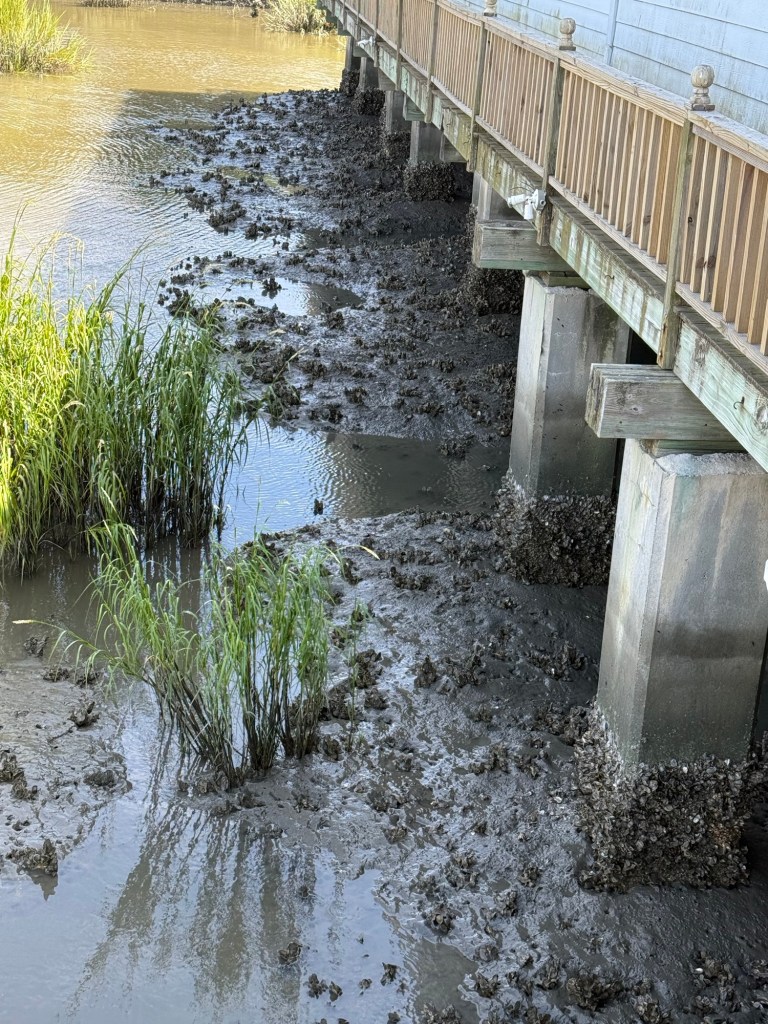
Fall on the coast carries its own kind of rhythm. The morning air wants to tease its fall but the days heat back up like summer. It doesn’t stop the evenings from ending with a fire glowing under a sheet of iron and oysters steaming in the shell. Friends and family gather round with gloves, knives, and laughter. At an oyster roast, it’s never just about the oysters. It’s about the firelight, the stories, and the fellowship that fills the night.

But before oysters ever reach the table, they’ve been at work. Each oyster spends its days filtering the water quietly, steadily, and without applause. They aren’t beautiful on the outside, but if you are lucky, you might find a pearl created by pressure and sand. One single oyster can filter as much as fifty gallons of water in a day. Multiply that by a reef, and you have a living system that keeps a bay clear, healthy, and full of life. Without them, the water clouds. With them, it thrives.

School leaders should be the oysters of our schools. They should act as filters. They should filter out the flood of initiatives, emails, disruptions, and frustrations that cloud the work. They should clarify the vision so teachers can see their way forward. They need to create an environment that allows students to flourish in the light. Without that filtering, schools can feel murky, heavy, and hard to navigate, but with it, everything is more transparent, calmer, and stronger.

Leaders are called to cultivate warmth and fellowship while creating a space where people feel connected and supported. Around the fire, trust and relationships grow. When nurtured, a school community strengthens. Filtering by the leaders keeps the water clear, but fellowship keeps the people going.

A school without leaders who filter is like a bay or river without oysters- clouded and struggling. But when leaders filter with wisdom and lead with fellowship, schools don’t just function. They flourish.

Reflection:

  • What’s clouding the work right now for your teachers or students?
  • How do you protect instructional time and teacher energy from distractions?
  • How do you know when the water is getting cloudy? What data or behaviors signal that to you?

More Than a Backpack

What Students Bring to School

My Why

If you have been reading any of my stories, you may have come to realize by now that they all stem from a place of experience and/or inspiration. This story is, by far, the most challenging one I have written. By sharing this, I’m revealing one of the darkest times of my life as well as opening old wounds and doors I have tried to keep locked. I didn’t experience this alone. My siblings also have their own memories of the events during this time, but this story is shaped from mine. If it can help one child sitting in one of our schools get help from their teacher or a school leader, then it has served its purpose. For that, I will be grateful! 

September and October are always tough months for me as I miss my mom greatly. One was her birthday month, while the other was the month she left this earth. So late-Lee, I’ve been thinking about her life… my life. I think about others who may share similar experiences, since October recognizes Domestic Violence Awareness Month. 

The Past

When I was in fifth grade, life at home underwent changes that no child should ever experience. After my parents divorced, my mom remarried, and what followed was years of violence that would shape the way I see myself and children forever.

For more than three years, the nights brought fear and chaos. I dreaded the way darkness from night would wrap around me like a weighted blanket. It wasn’t comfort that came with it. It was a pure fear of wondering which scene from the horror story would unfold next. I would lie awake hating the darkness. Even now in the quiet of the night, I can still hear my mom’s screams as she hit the wall, floor, or furniture when the monster pushed and shoved her. The sounds of his fists hitting against a wall or her pleading for the beast to stop echo in my nightmares. I would pull the covers up and try to block out the sounds, but it didn’t work. One night, (as I talked to her), he punched the refrigerator door so hard that it split her face open upon impact. The details changed, but the fear was constant. 

For years, I carried that trauma with me to school every single day. I went to class exhausted, eyes red from crying, and my body heavy with dread. My homework was undone. My reading was unfinished. I’m sure my teachers saw a student who wasn’t prepared, but the truth was, I had already survived more before the morning bell than most of my teachers could imagine. 

Once, in a desperate attempt to be noticed, I hurt myself quietly, hoping someone at school would ask why. No one did. I realized I was invisible. I learned to survive on my own.

Why This Matters for Schools

The research shows that children who experience domestic violence can experience feelings of terror, isolation, guilt, and helplessness. I can attest to this firsthand. I share my story not to shock you or to receive sympathy, but to remind every educator and leader that when some children walk into your school, they are carrying more than just books in their backpack. Like I did, they have their nights, their fears, their hunger, their heartbreak, and so much more I could list packed in it too. If we only measure students by the work they complete or the behavior they display, we risk missing what they most need: to be seen, to be safe, to be believed.

What Educators Can Do

You cannot change what happens in every home, but you can make school a place of safety and connection. Here are the steps that matter:

  • Notice beyond the assignment. Incomplete work may tell you more about a child’s life than their effort.
  • Create quiet check-in systems. A simple card or nonverbal signal gives students a way to ask for help without embarrassment.
  • Train staff in trauma-informed practices. Small responses, calm tone, private conversation, and quick referrals can change a student’s day.
  • Build adult anchors. Ensure that each grade level has a designated safe adult who checks in with identified students daily.
  • Use process data. Look at patterns of fatigue, frequent nurse visits, or sudden changes in engagement as signals, not problems.
  • Provide clear referral pathways. Teachers should know precisely how to connect students with counselors, social workers, and community support services.

Closing Reflection

I believe that when people see me, they see the smile I offer, the work I do, and the family I have, and I’m willing to bet money on this… they would never think I (or my siblings) experienced anything like what I’ve just shared. I was a child who longed to be seen. The scars I bear from those years remain. They remind me to extend more grace and love towards others. The truth is that many of our students sit in your classrooms today, carrying the same invisible weight. You may not see the bruises or hear the screams, but you can choose to notice the signs and choose to respond with compassion.

Let’s not forget compassion doesn’t replace instruction. It makes it possible. When students feel safe, valued, and loved, they are far more able to engage in the rigorous, high-quality learning experiences they deserve. A strong lesson plan matters, but so does the assurance that the teacher delivering it sees the whole child and wants to give them a learning experience that paves the way to a brighter future. 

As I wrote recently in When My Heart Makes Me Love You, love and learning are not separate tracks. They are threads that weave together to give students both the skills and the strength to thrive when they are desperately in a place that all they can do is simply survive.

Sunrise, Sunset, and Mindset

Late-Lee my school visits have had me up and out the door before the light of day. One morning, as I drove to school before sunrise, I watched the sky stretch open with streaks of orange, pink, and gold. That sunrise, so full of promise, reminded me of how we begin each school year with a bright vision, big plans, and energy for what could be. I even pulled over and snapped a picture, so that I’d have a reminder of that kind of hope.

By the time September slips toward October, the mood often shifts. Sure, the halls are trimmed with fall pumpkins and paper leaves, but the sunrise in August can start to feel like sunset by mid-fall. The weight of compliance reports, stacks of discipline referrals, data deadlines, and meetings that steal planning time all pile on. As my mama used to say, “You can’t pour from an empty cup.” And by October, many cups already feel bone dry.

I saw it recently. A principal stood in the hallway before the first bell. He wasn’t rushing to a meeting or scrolling his phone. He just stood there, shoulders heavy, eyes scanning the floor like he was carrying the whole building on his back. That look stayed with me. It was the look of someone whose sunrise was beginning to dim. I’ve seen that look before. I’ve lived it myself. I can remember finding a place in the halls where I could fall apart and get myself back together again without anyone seeing me. Those are the images most of the staff never sees, but they happen.

Here’s the truth: mindset matters. Our thinking shapes our capacity to lead, to teach, to keep showing up for students. In Train Your Mind, I wrote about the power of the questions we repeatedly ask ourselves. If we only ask, “What’s broken?” or “Why can’t this work?” the answers will drain the light right out of us. But if we shift the questions, even just slightly, to “Where is growth happening?” or “What small win can I celebrate today?” we start to notice the edges of dawn again.

My granddaddy used to say, “Don’t forget to dance with the one that brung you.” For us, that’s our students. They are the reason we began this work, the reason we press on through long days, and the reason every sunrise is worth holding onto. As leaders, we must work diligently to keep night from settling in. That’s where burnout lives! 

So how do we keep the sunrise alive when October feels like sunset and threatens to bring the darkness? 

For Teachers

  • Ask better questions during reflection. Swap “What went wrong today?” for “Where did students show growth?” or “Who did I connect with today?” These small shifts change the story you tell yourself.
  • Celebrate student wins out loud. When you see persistence, kindness, or progress, acknowledge it. Let students hear it and let yourself feel it. It builds resilience in both.

For Leaders

  • Protect the focus on learning. Eliminate non-essential tasks or reframe them so that teachers can stay focused on instruction and relationships. The way you prioritize signals what matters most.
  • Be visible with purpose. A few minutes in classrooms, listening, observing, and encouraging, can breathe light into weary teachers. Presence is a form of fuel.

And as folks around here like to remind me, “Every sunset is just making way for another sunrise.” The challenge (and the gift) is to train our minds to notice the promise of dawn, even when the sunsets are giving way to night. 

From Protecting to Empowering: The Real Work of Teaching

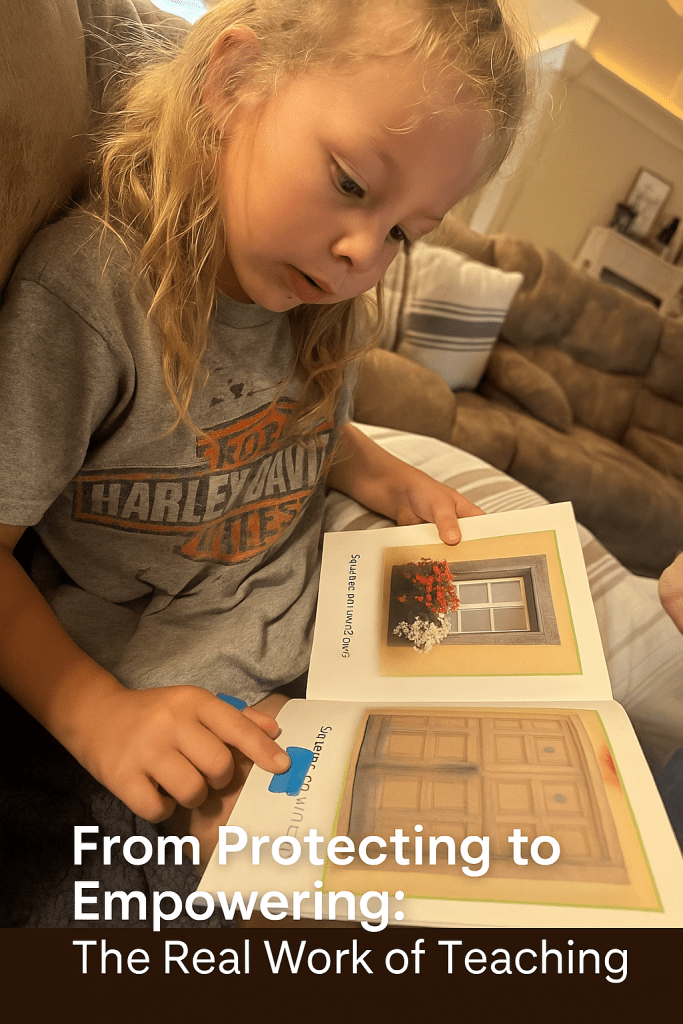
The other day, I was in a classroom when I heard a student with a disability say to the teacher, “Now I know how to read.” The student was so excited and undeniably proud. If hearing something like that doesn’t bring tears to your eyes, my friends, education may not be for you. It might be time to step away.

We shouldn’t enter education because it’s easy. Yes, the calendar can look appealing. Teacher contracts typically run for about 190–200 days, leaving nearly 165 days off throughout the year. On paper, it sounds great. But here’s the reality: some school leaders are so worried about teachers leaving that they avoid asking teachers to do the right work, or they don’t stop to consider what demands they’re making and whether those expectations are supported, resourced, and followed through.

Late-Lee, I’ve been hearing those types of comments from school leaders. The ones that describe not asking more of teachers, or they’ve already got too much on their plates. And it troubles me. Because here’s the truth, we can’t protect teachers from doing the right work. Yes, teaching is hard work. But it’s also heart work. It’s sacred work. Teachers are literally shaping the minds and hearts of children, and should be creating learning experiences that help them grow into thoughtful, capable, beautiful humans.

When I started teaching, I didn’t have the internet, state curriculum resources, or digital lesson planning tools that are available now. I had a paper planner book, and every single lesson had to be written out by hand. My evenings were spent poring over stacks of educational magazines, seeking creative ways to make learning both fun and meaningful and yes, aligned to standards since state assessments are not new. However, most states now provide rich curriculum units and resources that are already aligned to standards. AI technology can generate aligned lessons/tasks in literally seconds. The opportunity is there so we can save teachers valuable time on the planning side if we train them to use these resources well. That time can then be spent where it matters most: internalizing, visualizing, and rehearsing what strong instruction will look like in action.

And every child, no matter where they live, deserves that kind of teaching. A student in a small rural town deserves the same high-quality instruction as a student in a well-resourced urban district. Opportunity should never depend on geography.

So how do leaders make the shift from protecting teachers from hard work to empowering them to embrace the importance of the right work? It begins with courage and clarity.

Two steps to start:

  • Connect the “why” to the wonder. Remind teachers that their effort is not about compliance, but about moments like a child finally reading their first sentence that change a life forever. Anchor the hard work to the joy of watching students grow.
  • Support with love and follow-through. Hold high expectations, but walk alongside your teachers with resources, modeling, and coaching to support them. Accountability without compassion feels like pressure. Accountability with support feels like belief.

Leaders, I challenge you to walk into classrooms. Ask students what they aspire to become. Ask them what brings them joy. Look into their eyes and remember: you’re not just leading teachers, you’re shaping futures. Then ask yourself: Would you ever want a leader to settle for anything less than the very best for the children you love?

Cupcakes, Classrooms, and the Right Ingredients

When interactions were limited during 2020 due to COVID restrictions, I started teaching myself to decorate cakes and cupcakes to pass the time. Now, I’m no Cupcake Wars champion, but in the eyes of my grandchildren, I’m a winner. One of them is just like me. We focus on the sweetness of the frosting. I always seek out the corner piece of cake at potlucks or celebrations. I even had a dear friend who would send me her leftover frosting because she knows I do love hers! If she reads this, she’ll know I’m talking about her, and I want her to know I never forgot those yummy gestures!

This past school year, I baked countless batches of cupcakes, brownies, and cookies to share with the school I provided direct support. Of course, each batch had a theme. Because, really, a theme makes most anything better. It was my way of letting the teachers/staff know I appreciated their efforts at turning their school around.

But the other morning, I baked a batch for no reason other than for my grands who love chocolate cupcakes. While sifting the ingredients, I started thinking about how each one matters. Too much oil and you’ve got a greasy mess. Too much salt and you’re reaching for a firehose to hydrate. The right balance of ingredients is what makes them work.

Naturally that reflection carried me back to schools I have been visiting late-Lee. Recently, I walked into one that broke my heart. The classrooms lacked decor, worksheets topped the desks, and anchor charts were missing. I watched a teacher “instruct” by reading a passage, telling students what to highlight, and speaking in a tone that felt more like a performance than teaching. The students were polite and compliant, but they weren’t learning. Even the administrators told us, “The classes are boring.” And they were right.

I often write about the hum of a classroom. A room filled with students deeply engaged has a sound all its own consisting of a steady hum of curiosity and discovery. But these rooms weren’t humming. They were numbing! They had teachers, students, and lessons, but things weren’t quite mixed! The classes lacked the binders and leavening ingredients to ensure students were engaged in highly aligned quality lessons.

Room after room, we saw low-level resources, misaligned instruction, and teachers telling rather than showing. A teacher said, “You already learned that,” when she asked the students a question but not one student knew the answer. My thought? You may think you taught it, but it means nothing if they didn’t learn it.

The school’s climate was strong. Students were respectful and eager. The ingredients were there, but the recipe wasn’t working.

This isn’t unique to one school. It happens across this country. Leaders can’t just assume the right ingredients are in place. They must expect and inspect them. A simple first step? Visit classrooms often. In just five minutes, you can see if a learning goal is posted, aligned to the standard, and supported by an activity at the right level of rigor. The rest is just frosting.

Struggling schools often blame students, but I’ve baked enough cupcakes to know we can’t do that. When a batch flops, I don’t scold the cupcake. I check my ingredients, my process, and how I monitored them. Sometimes I’m messy, sometimes sprinkles scatter, but I don’t stop trying. I refine my practice so the outcomes come out right consistently. The work of improving schools doesn’t follow a straight path. It’s some of the messiest work you can be a part of, but when change happens and you can see it benefitting the students, it is the most beautiful work you will ever experience. So check the recipe you follow for your school, refine the process, and stir until it comes out right. That’s how we serve up learning sweet enough to make anyone smile.

From Clank to Courage: Leadership That Lifts Schools

I love a flag. I love watching it dance in the wind. I love hearing the clank, clank of the halyard against the flagpole in front of a school. Whether you believe in what the flag means is up to you, but for me, I believe in those who fought for the freedom it stands for. Late-Lee as I travel the roads to and from schools, I notice flags in all kinds of places. There’s one not far from where I live that waves proudly on a sandbar out in the river. You can admire it as you cross the bridge. A few times hurricanes have held it captive and whisked it away, but someone always replaces it.

I’m thankful for those who gave all so I could get an education when and where I wanted to. I’m grateful I can attend church when and where I want to. And I’m overwhelmed with the choices I get to make due to the sacrifices of others who fought for those freedoms. They’re the threads that make up the fabric of my life.

In schools, we have our own kind of “flag.” It may differ from the one that waves proudly outside the school, but it still carries deep meaning. It waves in the spirit of our teams: teachers, leaders, students, and families all stitched together with purpose. Like the Stars and Stripes on the flag, we may each be different, but together we unite in something greater: opportunity, hope, and a future for every child who walks through our doors.

But here’s the truth. A flag doesn’t rise independently. It takes applying some tension to pull the halyard with intentional movement. Leadership is the halyard in a school. Without bold moves from leaders, the school’s “flag” hangs limp and can’t possibly catch the wind.

Bold leadership doesn’t always mean flashy actions. Sometimes it’s the steady pull that raises the flag higher. Here are a few bold moves leaders may take. 

  • Coherent Instruction: If you want teachers to teach, don’t load their wagon so heavily that they can’t move forward. Provide the resources needed to plan and deliver effective instruction that is aligned to state standards and state assessment design. 
  • Effective Leadership: Feedback that rambles is like grits without butter; nobody’s going back for seconds. As I have shared in earlier posts, feedback is meant to be targeted, bite-sized, and actionable. 
  • Professional Capacity: If you want folks to grow, you’ve got to give ‘em room to stretch—just like tomatoes on a trellis. Provide tiered professional learning opportunities. Coaching cycles prove to be the most effective! 
  • Family & Community Engagement: Families don’t just need a seat at the table. They need a fork too. Invite them in to be a part of the learning community. 
  • Supportive Learning Environment (MTSS/Whole Child): Talking without acting is like thunder with no rain. You hear plenty of noise but nothing that helps the crops. Ensure you are monitoring data closely and students who need extra support are getting it. 

Like raising a flag, these moves require effort, intention, and courage. But when leaders commit to pulling the halyard, the school’s colors can wave proudly, signaling a place where students thrive and teachers feel empowered.

So maybe the next time you hear the clank, clank outside your school, let it remind you: what bold move am I making to raise our flag higher?

Catching Success

I’ve been thinking about shrimp boats, late-Lee. I’m always impressed by the magnificence of a shrimp boat. It’s not that it’s full of glitz and glam. In fact, it’s more the grit and grime that draws me in. I like the ruggedness of it…the sturdiness of it. I like its imperfections, etched in the architecture of it by the history of its travels. Many of these boats are named after women, a tradition that honors legacy and luck. If I were to name one, I would call it Miss Late-Lee. Wink wink! 😊

Every voyage has the captain and crew hoping for a bountiful shrimp catch. Some days the drag of the nets are heavy, and some days they appear empty. Each catch (or lack of) guides the next decision.

Like shrimpers, our school crews can’t simply press on without adjusting course from time to time. A crew’s success depends on constant monitoring and awareness along with the willingness to adapt. The same is true of our school teams. In response to various conditions, the school’s nets may need to be raised or lowered. They may need to press into the wind facing it head on or shift direction.

Often the study and creation of school improvement plans is seen as an event that gets checked off as complete. Then these plans are forgotten about until the next year. That behavior is compliance focused. Strategic plans may need to be refined. The goals set in May/June don’t always hold once baseline student data starts rolling in. Leaders may have to shift priorities, redirect resources, or reset timelines so the plan matches the current waters.

Instructional practices may need to be modified. Teachers don’t abandon the work, but they may use data to inform the instructional course they originally charted. They widen the net by making adjustments such as how they are reteaching, regrouping, or changing approaches to ensure students catch on.

Student behaviors may need to be addressed. Like storms at sea, behaviors can throw a course off quickly if they aren’t acknowledged. Tackling them directly creates the calm seas necessary for learning to stay on track.

Monitoring has to stay constant. Shrimpers watch the tides, winds, and catch size to know when to stay and move. In schools, leaders should monitor focus areas, review data, and check lesson plans, and review student work.

Like the captains and crew of shrimp boats, school leaders and teachers can’t just depend on the excitement of a new year to carry them through. Grit matters more than you think. Just as shrimp captains lean on experience and memory to navigate tricky waters, school leaders need to rely not only on data but also on their deep understanding of their school culture and environment. How are our leaders supporting crews when change fatigue kicks in? Student behaviors escalate? Or when having to adjust the plan when the nets come up light? One way is to communicate with and involve the teachers. In most cases, they just want to understand the why.

We can’t just sit still when the nets come up light. And when the waters get rough or the catch feels thin, that’s when we anchor up, reset our course, and keep moving forward. Because when we do, the catch of success will come.

As leaders, how would you respond to the following questions?

  1. What does the data reveal about possible refinements we need to make to our current plan so we may stay on course?
  2. How are instructional practices being modified so students are truly catching on?
  3. What systems are in place to monitor progress and ensure we don’t lose sight of what matters most — our students?

As you reflect on these questions, think about your processes. If you don’t have a solid response backed by evidence of practice, you may need to develop a plan.

If I ever did name a shrimp boat Miss Late-Lee, I’d want her to be known for the way she stayed on course, adjusted to the waters, and always brought her crew home with purpose. That’s the same kind of leadership our schools deserve. Anchor up…

Red Lipstick and Real Feedback- The Right Shade of Growth

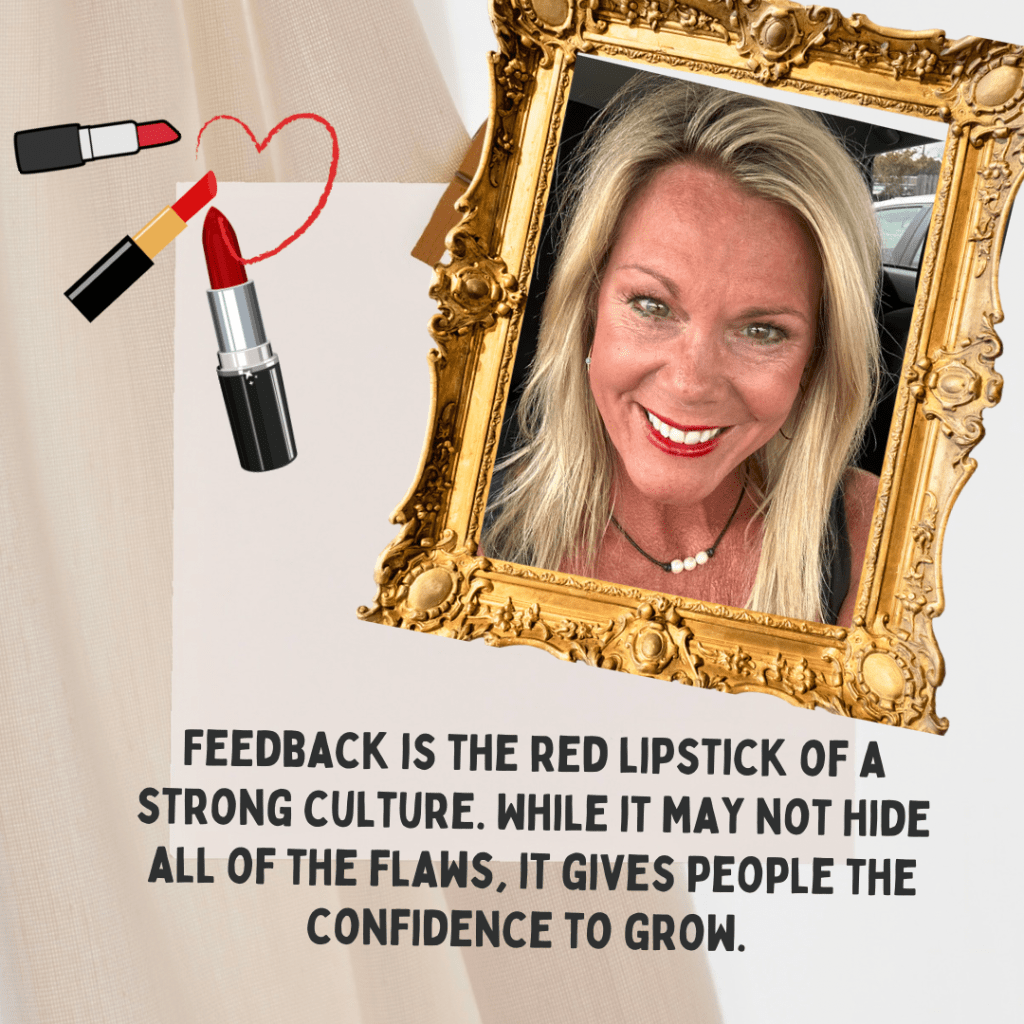
Late-Lee I’ve been thinking about my favorite red lipstick. It’s the one I reach for even on the days when I don’t feel my best. That little swipe across my lips doesn’t erase the crow’s feet around my eyes or the tired look staring back at me, but it gives me just enough lift to walk out the door with a little more confidence. Some days I tell myself, “It’s a red lipstick kind of day.”

That’s what good, targeted feedback does too. It doesn’t fix everything overnight, but it gives you the courage to take the next step. It shines a light on what matters most so you can make the adjustments that help you do better and be better. And here’s the key: it has to be honest. Polite compliments might feel nice in the moment, but they don’t move us forward. Honest feedback, given with care, is what builds confidence and sparks growth.

I know this first-hand. In my current role, I have two amazing mentors I lean on. I ask them for feedback because I want to keep growing. After nearly forty years in education, you might think I’d have it all figured out by now, but truth be told, I crave it. Their words lift me up, stretch my thinking, and remind me that growth doesn’t come with an expiration date.

I’ve also seen what happens when a whole school leans into this idea. I once worked with a principal who didn’t just talk about feedback, he embraced it. Together, we built a team of teachers who started doing peer observations. We coached them to use an observation tool, calibrated our ratings, and sat down to debrief on the highest-leverage moves. Then came the real magic—we watched those same teachers practice giving feedback to one another.

Y’all, it was powerful. Relationships started to change right in front of me. The teacher receiving feedback grew, but the one giving it grew by leaps and bounds. It gave me chills. It felt like watching a school transform into a true learning community where everybody was teaching and everybody was learning.

In Coaching from the Sidelines, I wrote about how growth only happens when folks are willing to be open. That doesn’t just appear out of thin air. It takes a culture that makes feedback safe, honest, and connected to growth. I find that some people are just offended when feedback is given. I struggle with that mindset because I want feedback.

And in Beyond the Shine: Looking for Evidence of Learning, I reminded leaders that quiet classrooms and perfect bulletin boards don’t always mean students are learning. Just like lipstick doesn’t erase my wrinkles, appearances don’t prove progress. You have to be willing to look deeper.

Here’s where it all ties together. Real feedback isn’t about pointing out flaws, it’s about giving people the courage to grow. My lipstick doesn’t change who I am, and honest feedback doesn’t change a teacher’s worth. Both just give us the confidence to keep showing up and doing the work.

When a school embraces this, everything shifts. Conversations move from criticism to courage. People embrace the feedback and use it to impact what really matters. You can feel it in the halls. It’s a culture that says: “We’re in this together, and we’re all going to grow.”

So yes, I’ll keep wearing my red lipstick. Not to present myself as perfect. I am far from it. I wear it as a reminder to step forward with confidence. And I’ll keep believing schools can do the same by sharing feedback that is honest, encouraging learning that runs deep, and recognizing growth is the shade everyone wears.

Beyond the Shine: Looking for Evidence of Learning

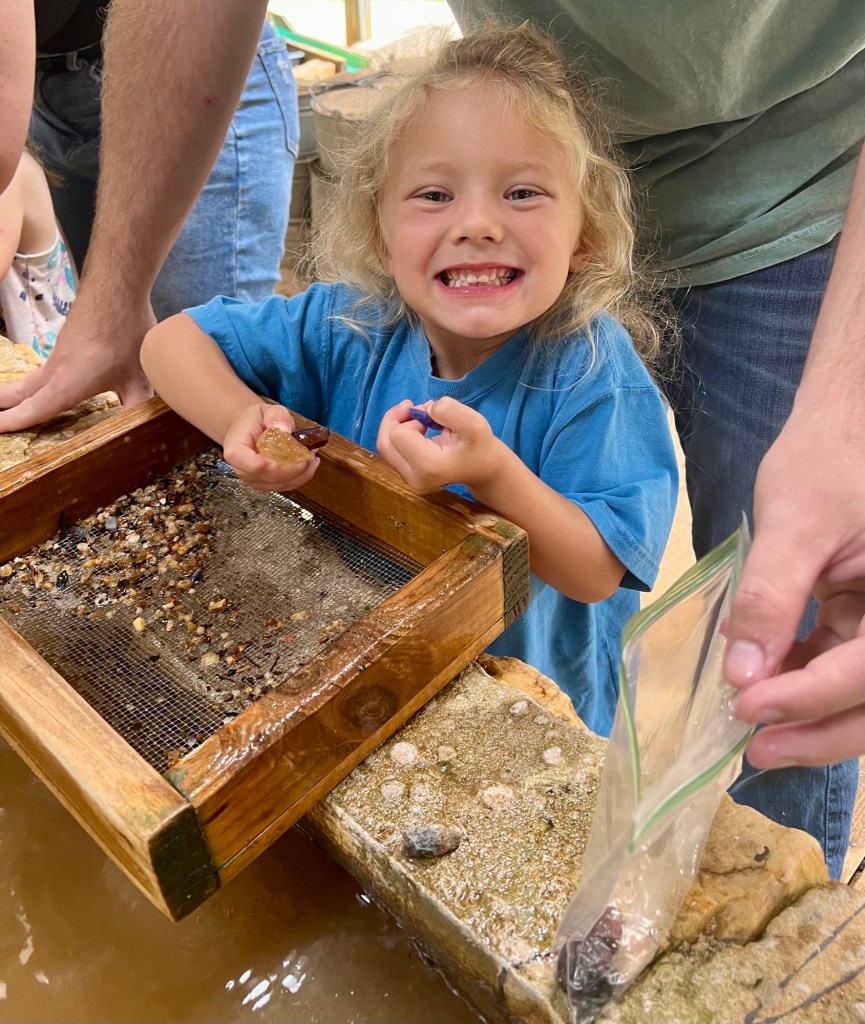
Late-Lee, I’ve been going through old photos trying to purge some to make room for others. I ran across a set from when I took my granddaughter to a gold mine. I had a good giggle remembering how excited we were when we found those little fragments of shiny “gold” only to learn it was pyrite. She learned a new word, but her bank account wasn’t any richer.

That memory came back to me recently as I was visiting classrooms with school and district leaders. The rooms where students were quiet and well-behaved were getting the highest ratings. On the surface, everything looked calm, orderly, almost picture-perfect.

But here’s the problem: when I looked closer, I didn’t see alignment between what students were doing and the standard they were supposed to be learning. People who work alongside me know that the first thing I’m doing is pulling up my state’s standards and testing resources so I can compare the work students are busy completing to the level of the state assessment. And if school leaders aren’t doing that same comparison, how can they honestly say there is rigor? In these classrooms, the match wasn’t there. The students weren’t talking to each other. They weren’t grappling with ideas. They weren’t engaged in meaningful work. The teacher was active, but the kids weren’t the ones doing the learning.

It reminded me how easy it is to get caught up in what I call the “happy shiny features” of a classroom. Quiet can feel like control. Neat rows can feel like structure. A compliant class can look like a successful one. But none of those things automatically equal learning. When students are simply interacting with rote activities, they aren’t exercising critical thinking. If they aren’t writing when reading, there’s no connection between interpreting and constructing text. When they’re just plugging and chugging math problems, there’s no analysis or evaluation of mathematical concepts.

As leaders, we have to inspect closer. Just like panning for gold, it takes some sifting to separate the obvious from the real thing. Instead of stopping at what looks good, we need to ask:

Is the task aligned to the standard? Are students doing the cognitive heavy lifting? Is there evidence of student discourse and engagement? Can I see the learning happening, not just the teaching?

Great leadership requires us to resist being dazzled by surface-level shine. Remember, all that glitters is not gold. And if you have ever panned for gold, you know exactly what I’m talking about. In the end, we’re not in this work to create quiet classrooms. We’re here to create learning ones. Our role is to help grow teachers into their best selves, supporting them with the kind of coaching and feedback that sharpens their practice. When we do that, we’re not just refining instruction. We’re cultivating robust learning environments where students can think deeply, engage fully, and thrive.

(In my last post, Coaching from the Sidelines, I shared a practical coaching frame leaders can use to move teachers past surface-level shine and into meaningful learning. Check it out if you need a framework for feedback.)

So next time you walk into a “happy shiny” classroom, pause and look deeper. Don’t just celebrate the appearance of success. Celebrate the evidence of learning. Because in the end, we aren’t here for shiny. We’re here for bold, messy, thoughtful work. The kind that sparks real learning.That’s where the real shine is.

Coaching From the Sidelines

Late-Lee I’ve been thinking about football season. It’s upon us and with it comes all of the cookouts and cheers! While everyone cheers for the great plays, I’ve been paying close attention to the sidelines. Coaches don’t just stand with their arms folded. They pull players aside, break down what just happened, and point to what comes next.

That immediacy matters. A quarterback throws an interception and the coach is there seconds later, “Plant your foot before you release. Slow down your read. You’ve got this! Let’s try again.” It’s specific, focused, and built on the belief that the player can grow and improve the next play.

Classroom teachers deserve the same. But simply saying, “Leaders should give feedback,” isn’t enough. Feedback without a frame can feel random or overwhelming.

Here’s a coaching frame that works at every level including district leader to principal, principal to teacher, and teacher to student.

Name the strength. Start with what worked. Growth sticks best when confidence is affirmed.

Name the focus. Identify one small, high-leverage move that will have the greatest impact. Don’t try to fix everything.

Model or describe the adjustment. Show it by giving a clear example of what it should look like in practice. Make sure the person receiving the feedback is clear about what it should look like by having them share their understanding in their own words.

Practice or plan the next step. Have the person try it immediately with you and plan for when they’ll implement it next.

Follow up. Circle back. Feedback without accountability fades quickly. Observe the implementation of the feedback to close the feedback loop.

For the coaching cycle to be effective, leaders must calendarize the work. Observations need to be on the calendar as should the feedback sessions. By calendarizing the feedback session with the teacher, the accountability for ensuring the observation takes place is built in.

The truth is a football coach doesn’t have to have played every position to recognize what effective plays look like. In the same way, leaders don’t have to have taught every grade level or subject to spot strong instruction. What matters is staying focused on what grows people, not just what checks a box.

The part leaders sometimes miss is feedback isn’t criticizing someone for not doing it the way you would have done it. Coaching isn’t about creating replicas of ourselves. It’s about helping others refine their craft in ways that make student learning stronger.

For feedback to work, there has to be a growth mindset on both sides. The player has to be open to hearing it, and the coach has to be intentional about giving it. In schools, that means district leaders coach principals, principals coach teachers, and teachers coach students. Each layer invests in the next.

Champions are made when feedback is expected, specific, and used.

The Leadership Lessons of an Octopus

I saw a news story awhile back that stopped me in my tracks. A six-year-old boy had to be rescued after an octopus in an aquarium reached out of its tank and grabbed his arm. I would have lost it had I been his mom.

He’s okay, but I’m sure he was terrified. Thankfully he is fine. Still, I haven’t stopped thinking about that octopus. That thing reached right out and did what octopuses do. No hesitation. No need for approval. Just instinct and action.

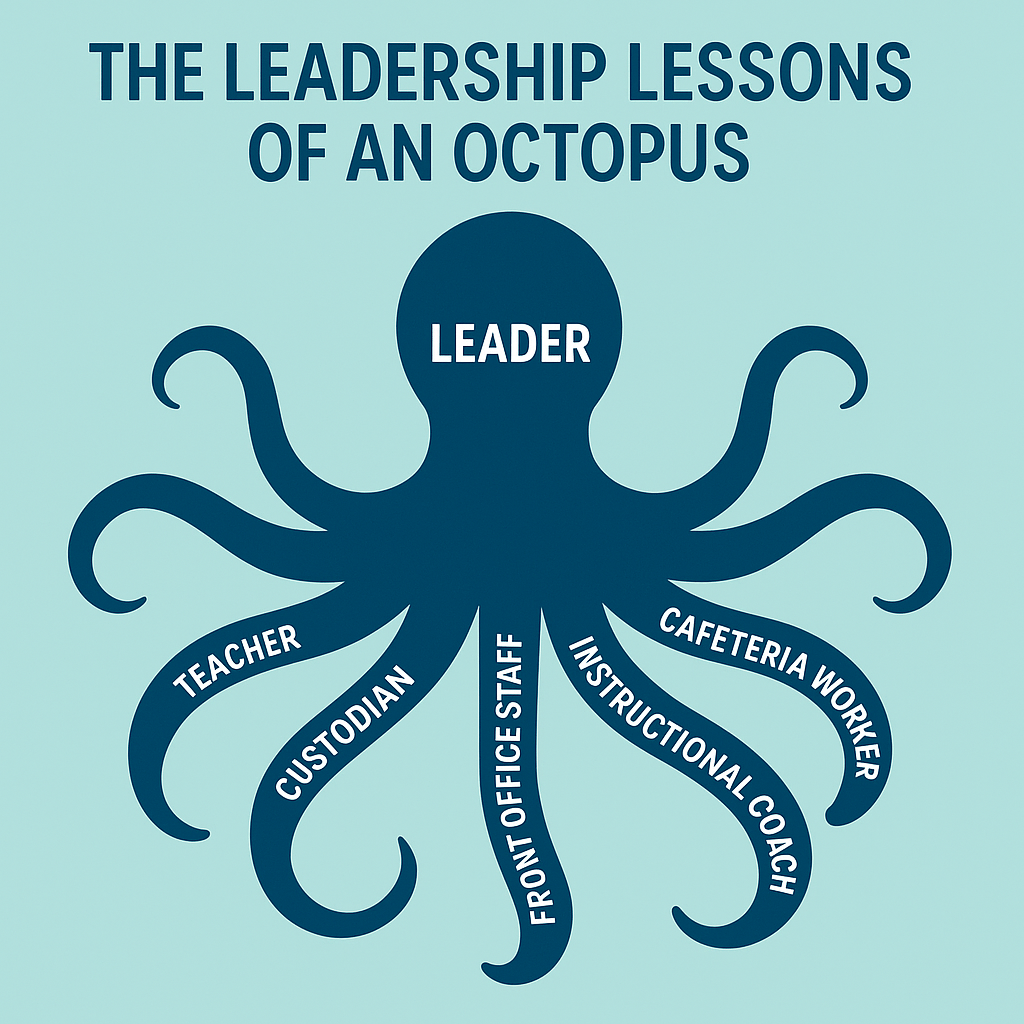
Turns out, octopuses are built for that. They have eight arms that can work independently from their brain. Each arm has its own kind of intelligence. They can taste, touch, and respond to the environment without needing to check in with headquarters. But even with all that independence, the octopus still moves with coordination and purpose.

So late-Lee, that octopus has had me thinking a lot about schools.

A strong school doesn’t operate because one person is controlling everything. It works because everyone knows the direction it’s heading, and each person feels trusted and equipped to do their part. Teachers, office staff, custodians, paras, cafeteria workers are the arms of the school. Each one is capable of taking action in the moment.

A teacher sees a student in distress? She acts.

A custodian notices a safety issue? He fixes it.

The front office gets word that a family’s going through something? They respond with heart.

They don’t need to wait for the principal to give them permission. They don’t need to write a proposal or schedule a meeting. They know what to do, and they do it, because strong leaders have built a culture where people are trusted and the mission is clear.

If you’re a school leader and your team can’t move without your say-so, that’s not leadership…that’s a bottleneck.

A truly strong leader sets the direction, models the values, and creates the conditions for people to lead from wherever they stand. You don’t have to be in every hallway if your team knows what matters.

That octopus might have been in a tank, but it wasn’t sitting idle. It was watching, sensing, reaching. Doing what it was created to do. That’s the kind of school leaders should want to see. Every arm should be alert and active. Everyone should work together to serve kids well.

So no, I haven’t lost it. I’m just saying… maybe the octopus is onto something.

Teaching Like a Blue Angel

A friend of mine recently told me they had seen the Blue Angels perform. I was jealous. A recent opportunity was rained out. Still, I’ve watched enough videos of them to be completely captivated. There’s something about the precision of their flight. The way they move in perfect sync is an orchestrated beautiful moment. The trust they place in one another is inspiring and is the direct result of strategic practice and communication.

But what struck me the most was watching a behind-the-scenes video showing them running through their flight plan with their eyes closed. You could actually see them visualizing each maneuver as they internalized every turn, every roll, every shift in formation. They weren’t just going through the motions. They were preparing their minds and their bodies to execute something with precision and excellence.

So late-Lee I found myself thinking about the idea of visualizing and internalizing what the lessons we plan for students will look like when delivered. Why don’t we consider what we are doing for our students as important as what this elite group of pilots are doing?

I’m not talking about performing for an audience. But, in actuality teaching is as much art as it is science. We do have an audience and it is our students. I’m talking about being intentional and I mean deeply intentional about the way we plan. And, I don’t mean picking up a textbook because the company says it’s aligned. ( Don’t get me on that soapbox!😊)

Some districts feel like they are helping teachers by giving them prepared lessons. Our state even has phenomenal math units. And in the review of that math unit, one of the first steps is to internalize it. Are teachers being coached through that process?

Think about it, once a lesson is planned, teachers should take the time to close their eyes and visualize their lesson before delivering it. What do you see yourself doing? What are students doing? Where might they get stuck? Have we planned in the safety nets? What will the energy in the room feel like? I tell leaders that I walk into classrooms with, that one of the first things I do is pause and feel the room. If it’s flat, I know the learning will be too. What will you do after the lesson when you review the assessment data? What’s your plan to reteach, to enrich, to adjust? The answers to all of these questions and more need to be thought out and planned for in advance. It’s part of the maneuvers great teachers should make!

The Blue Angels don’t just show up and fly. They practice. They review. They revise. Because lives are on the line.

And while we may not be flying fighter jets, we are shaping futures. We do have lives on the line. We’re preparing students for a world we can’t fully predict — and that’s just as serious.

So let’s plan like it matters. Let’s visualize like it’s vital. Let’s teach like Blue Angels.

There’s a Heartbeat Behind the Data

Late-Lee, I’ve been thinking a lot about the resistance some teachers still have when it comes to using data. I’ve heard all the arguments—kids aren’t numbers, we teach humans not test scores, this data doesn’t tell the whole story. And I completely agree. But here’s the thing: using data doesn’t mean you’ve forgotten the heartbeat behind it. Data isn’t one of those four letter words. 

My last post, Play the Right Words, emphasized the need for leaders and teams to analyze data in order to take action. The other side of this story is how teachers should also analyze data daily.

When I go to the doctor and say something doesn’t feel right, the conversation doesn’t stop there. The doctor starts collecting information. He/she asks questions, takes vitals, checks my ears, listens to my lungs, maybe even orders labs or a scan. It’s all data. Why? Because they can’t treat what they don’t understand. They need evidence to make the right call.

That same logic applies in classrooms.

If a student isn’t performing well on a diagnostic test, that’s just the beginning. It raises a red flag indicating we need to look into it and not simply accept the score. We need to observe the student during lessons (data), take note of how they interact with peers (data), and offer smaller, more targeted assessments to figure out what’s really going on (you guessed it…data).  When we start digging deeper we find nuggets of opportunities.

And then? Just like in medicine, a prescription may be written. Maybe it’s instruction in a small group, a scaffolded lesson, a graphic organizer, a specific reading strategy. Maybe it’s all of those. But no good doctor (or teacher) just sends the patient off without a follow-up. They continue to collect data to see if the intervention is working.

The data doesn’t replace the heartbeat. It honors it. It says, “I see you. I want to help. And I’m going to make sure what I’m doing actually works.”

So maybe the problem isn’t the data. Maybe the problem is how it’s been framed. As leaders, we need to ask ourselves to reflect on this practice. In what ways do we need to own some of this? Did we communicate in such a way that made teachers feel like data was the most important thing rather than a piece of the story about the most important thing…the student? 

So how do we change this mindset? I urge teachers to ask for guidance if you aren’t sure how to collect the right data, triangulate the data, and determine actionable next steps. Maybe leaders have assumed you know. But, I’ve worked with many leaders who struggle with that too and it’s okay. We all have the ability to learn. 

Data isn’t the enemy of heart. It’s the tool that helps us respond to it.

Play the Right Words

Late-Lee, after a long day of coaching, thinking, overthinking, planning, fixing, nudging, and all the other “-ings” that come with this work, I like to unwind with a little game of Words With Friends. It’s my way of cleansing my brain palate before bed.

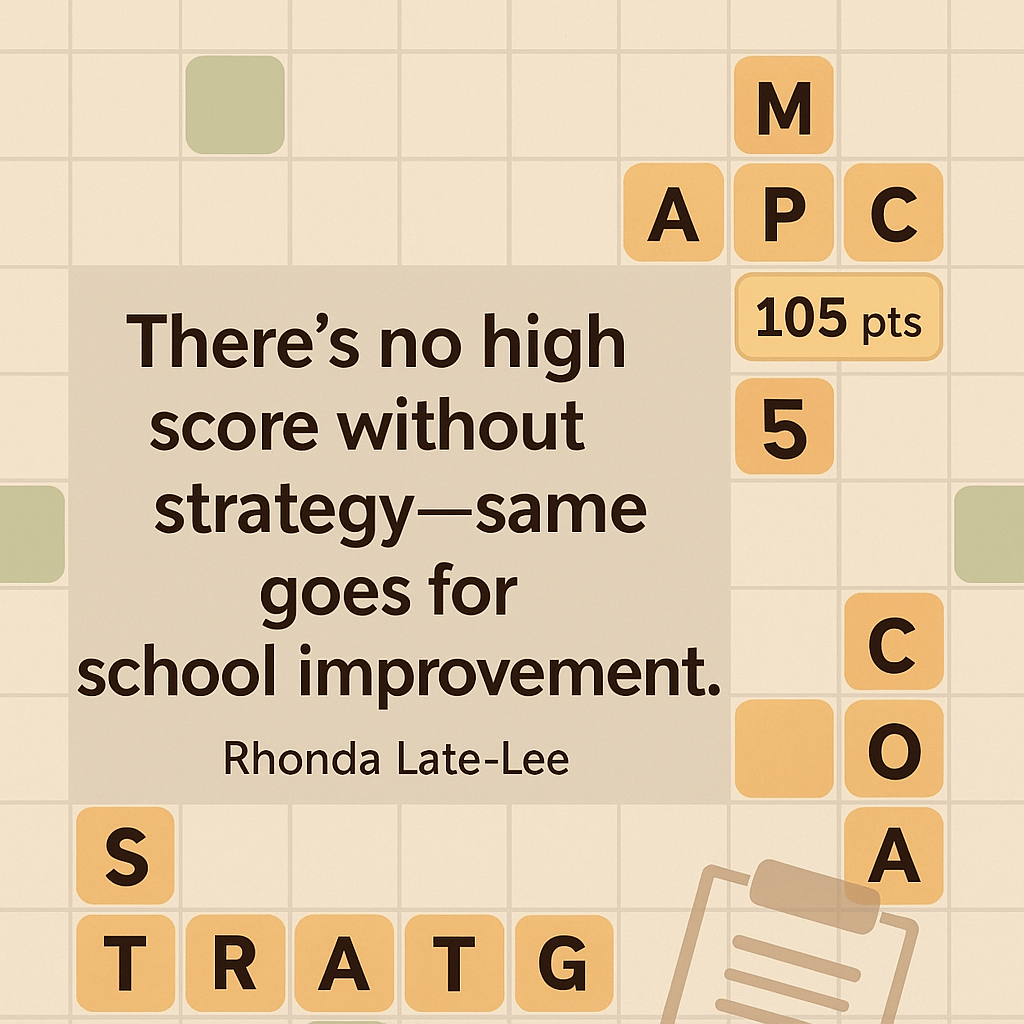
Now, I’m not saying I’m a champion or anything. In fact, I lose a lot. But I’ve played with some serious wordsmiths. The other night, one of my friends messaged me a screenshot of a single word she played that racked up 105 points. One word. 105 points! I was so impressed, I told her she needed to teach me her secrets. Her response? “Girl, it’s strategy.”

And naturally that got me to thinking. 

Strategy. That’s what this work of improving student achievement and schools requires. Just like in the game, where each letter and move is chosen for maximum impact, educators have to be intentional in every decision they make. We shouldn’t just look at data.  We shouldn’t just report out on the data. We need to triangulate it.  I have heard someone even say, “We torture it until it confesses.” We don’t just react to problems. We use questions like shovels and dig beyond the surface for the root causes. 

A superintendent I used to work with (and admired greatly) would always tell us, “Hope is not a plan.” We didn’t just hope something would work.  Like the careful selection of every letter in the game, we would choose actions that were most likely to make a difference in addressing those root causes. We’d monitor those actions, and if we weren’t getting a high score, we’d adjust. 

There’s no high score without strategy.

So whether you’re figuring out how to support a struggling leader, teacher, improve Tier 1 instruction, or move a school out of CSI status, remember what I often tell those I work with, “School improvement can be some of the most challenging and messy work you will ever do, but it is also the most beautiful and rewarding work.”  There isn’t always a clear path through it. When you are dealing with so many variables, you have to look beyond the obvious moves. 

While it seems hard, it’s winnable. You just have to play the right words at the right time and sometimes that means passing on the easy move to wait for something better.

Just like in the game, it’s not about winning every round. It’s about staying in it, thinking ahead, and making every move count. You don’t just abort the mission. As this school year begins, commit to using all types of data. As we all know our students are more than a number. Every data point you analyze has a heartbeat behind it. We need to monitor the outcomes to ensure our students are getting our very best.

Teach Like a Butterfly Farmer

Late-Lee, while walking, I’ve been noticing  the butterflies flitting from flower to flower free, light, and beautiful. The other day I paused to watch one of them and remembered how much I used to love teaching the butterfly life cycle to my students. We’d read, “The Very Hungry Caterpillar”, observe caterpillars in jars, and celebrate when they finally emerged from their cocoons. We’d have a grand send off as we set them free!

And per usual, it got me thinking about the new school year which is now right in front of us. I’m not sure if teachers ever considered this, but as I reflect, I truly believe teachers are in the business of metamorphosis. And, when they carefully tend to those in their care, they have the most beautiful opportunity to not just grow minds, but to also grow wings.

When students enter your classroom, they may come in as crawling caterpillars who are unsure, hungry, and maybe a little guarded. But you have the power to unlock their potential and give them what they need to grow. In general, students need structure, safety, nourishment, and challenge to thrive. It may not look like much is happening on the daily. But remember, while a chrysalis doesn’t seem exciting on the outside, there is something powerful and almost magical happening on the inside.

That’s what great teaching does. Every question you ask. Every expectation you set. Every encouraging word you offer helps shape a student.  And slowly, transformation happens. Confidence takes root. Wings begin to form.

By the end of the year, your goal shouldn’t be for them to know more. Your goal should be for them to be more.

They should leave your classroom not just smarter, but stronger.

PS: Remember the Weed?

If you’ve been following me for a while, you might remember Be Like the Weed, my reflection on resilience and grit. Weeds grow where they’re not supposed to and still find a way to bloom.

Butterflies remind us that growth isn’t always fast, but it is beautiful.

Weeds show us how to survive.

Butterflies show us how to become.

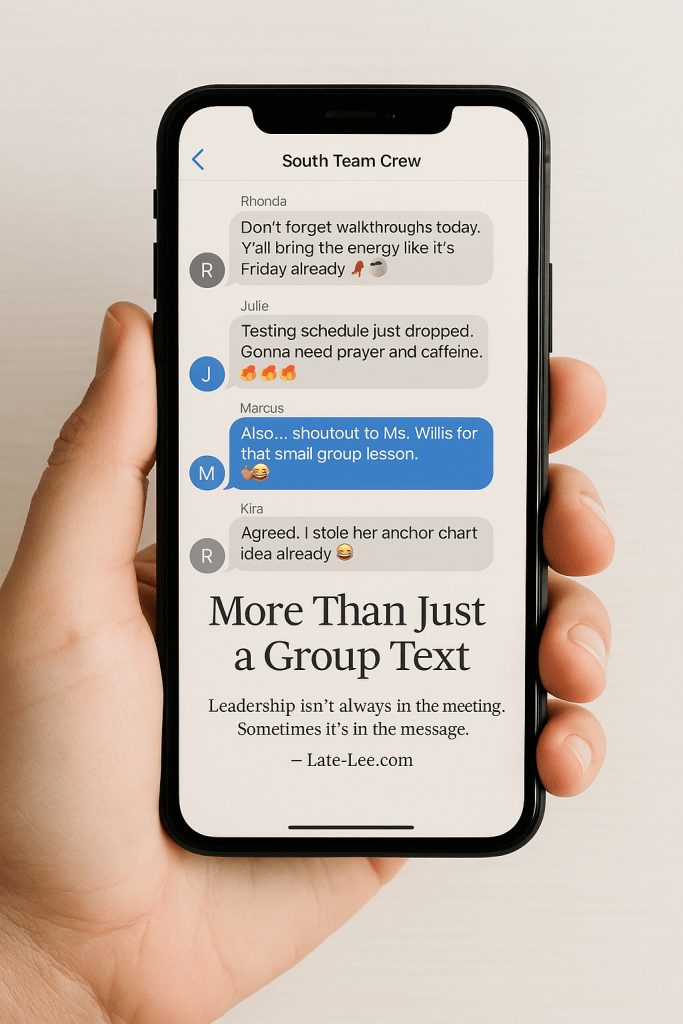
Culture in a Text Thread 

A different take on leadership, relationships, and the little things that build a culture

There’s a family group text that stays pretty active in my world. Someone’s always sharing a funny picture they came across, sharing photos of themselves or my beautiful grandchildren, dropping a screenshot of a receipt we need to settle up, or planning who’s going where for the next visit. Sometimes it’s a celebration like someone getting recognized at work and sometimes it’s just someone venting about a long day. The tone swings from hilarious to heartfelt, and somehow, it always brings us back to each other.

Then there’s the team group text. It’s where we share reminders, shout out small wins, and drop in a “Happy Birthday!” or “Happy Anniversary!” when someone hits a milestone. Prayer requests get lifted up, and every now and then someone shares a success or a strategy that worked like a charm. It’s a blend of encouragement, celebration, and support. And over time, it becomes more than just a thread. It becomes a thread that weaves our lives together. 

Years ago, when I was a principal, we used a Facebook Messenger group for our school staff. It wasn’t fancy. But it was real. We celebrated birthdays, shared reminders, connected during storms, grumbled a little, and honestly, that string of messages held us together more than a lot of formal meetings ever did.

So late-Lee, as I reflect on ways to bring people together and create a space of belonging. I’ve come to believe that group chats, when used with purpose and care, are one of the most underestimated tools in a leader’s toolbox.

Not because they’re professional. They aren’t.  Not because they replace protocols or agendas. They don’t. But because they offer something most leadership manuals forget to mention. It can be a way to create a sense of belonging. As school leaders welcome new staff members, be mindful of the fact that often they are joining your school family with some angst. They are going to have to learn how to navigate your school expectations (written and unwritten), make new friends, and familiarize themselves with a new community. They don’t quite feel like they belong. Help give them that sense of belonging. No meeting will ever do that, but a genuine connection will. 

They say culture is built in the small moments, and a group chat is full of small moments. It’s a place where encouragement is shared in real time. Questions can be asked without a formal meeting. Wins get recognized quickly. And people start to feel like a team, not just a staff.

As a leader, you set the tone. You don’t have to be the one sending a meme or message every day, but your willingness to show up as a human not just a boss opens the door for others to do the same.

So the next time someone says, “Hey y’all, should we start a group text?” Don’t dismiss it as fluff. It might just be the best leadership move you make all year.

School Culture Isn’t Just Surface Level

Late-Lee when I’m out on the river or chilling in my pond, I’ve been thinking a lot about undercurrents like the ones you find in rivers and oceans.  You can’t see them, but they are lurking just below the surface. You will feel a silent pull that moves various things you can’t always see, but you definitely know they are there. If you’ve ever been swimming and felt something brush against your leg, you know exactly what I mean. Sometimes it’s seaweed. Sometimes it’s trash. But whatever it is, you didn’t see it coming, and it catches you off guard. If you are like me, you pray it isn’t a snake! 

School culture isn’t just about what’s seen. Sure, you can decorate bulletin boards, wear team shirts, and plan a monthly potluck. And to an outsider looking in, they might be mesmerized by the beauty of it all. And while all of that has its place, the deeper truth is this: culture is more about what’s felt than what’s posted. 

School culture has its own version of undercurrents. Maybe it’s unspoken frustrations. Perhaps it’s gossip passed in hallways or the infamous eye rolls in meetings. At times, it’s the tone behind the words that are shared in various contexts. It’s in the sound of the sighs expressed when unpopular information is communicated. It’s the quiet resistance. Much like the things floating beneath the surface of the water all of these things (and more) can catch even the best leader off guard. 

Teams blame it on leaders, but leaders can’t do it all, and this is especially true when it comes to culture. They can set the tone, model professionalism, celebrate the wins, and call out what’s not okay. But culture isn’t something leaders can dictate. It’s something that is co-created. Let me say that again…co-created! 

Teams have a responsibility in this creation too. If there’s an undercurrent of negativity, no amount of surface-level celebrations leaders try to implement is going to fix it.  Leaders can host “Jeans Day” every Friday, but if collaboration feels forced or colleagues feel isolated, the undercurrent still flows moving the negativity throughout the building. And eventually, it pulls people under. People leave.

Here’s the hard truth: leaders can’t force adults to be friends. They can’t even make them be nice. But they can expect professionalism. They can expect grace, kindness, and respect to be part of how the work gets done. Leaders do have a big stake in the creation. They must be available to their teams. They need to be approachable and open to ideas.

Great culture isn’t an event. It’s a daily decision by every person in the building to either fuel the undercurrent or help shift it. When members of any team starts saying, “Morale is low,” they need to follow it up with, “What can we do to improve it?” It’s not about pointing fingers at any one person. (My mom used to remind me that when you point a finger there are three pointing back at you.) It goes back to everyone making a daily decision to be co-creators!

In just a short couple of weeks, school doors will open to the many scholars educators are going to teach. Teachers have already begun decorating their rooms and preparing in a variety of ways for their arrival. There are still numerous smiles on the faces of teachers as they gear up for the new year. But the undercurrent is there lurking…waiting. I challenge each school team/leader to fully commit to preventing the inevitable shift in tides that occurs almost like clockwork (once the reality of the year has kicked in) from allowing undercurrent to become negative.

Be lifeguards for one another and throw out smiles and support like life preservers to ensure the school culture stays healthy and afloat. It takes everyone!