
 by
by (Part 3 of the “Recalculating” Series)
Haven’t read Part 1 or Part 2, be sure to check those out first.
Speaking as someone who is directionally challenged, and as I’ve shared before, I can get lost in a parking lot. I feel a genuine sense of accomplishment when I actually end up where I intended to go. That doesn’t happen by chance. It’s because I use my GPS to guide me. I’m certain, with its help, I could find my way to New York. In much the same way, when we use our standards to chart the course for learning and check in along the way, we give ourselves the chance to either recalculate or celebrate.
But just setting a destination isn’t enough. Along the way, I have to glance at the map, listen for turns, and sometimes reroute when I miss one. Teaching works the same way. Standards help us know where we’re headed, but it’s the lesson check-ins such as the effective questions, the short formative assessments, and the student work in front of us that tell us if learning is actually happening. When we take the time to look closely at that evidence, we can make decisions that keep students on the path toward mastery, rather than assuming they’ll find their own way there.
I’ve learned that if I don’t stop and check my direction, I’ll keep driving in the wrong direction with complete confidence. The same thing happens in classrooms. Teachers can teach their hearts out and still not be certain if the lesson was aligned to the rigor of the standard or if students are actually learning it. When you ask one or two students who know the answer, that is not confirmation they all know. That’s where formative checks for understanding come in. They’re like little landmarks along the way that help us see if students are actually getting there. It doesn’t take fancy tools or long tests. It simply requires a clear look at the work before us and an honest conversation about what it reveals. It’s important to also acknowledge those outcomes reflect our instruction. That’s the kind of intentional pause that helps teachers recalculate when needed and celebrate when learning sticks. That’s the kind of teaching that is steady, purposeful, and always headed in the right direction.
So, late-Lee, I’ve been thinking about this whole process. I struggle to understand where the disconnect is and why this seems to be such a challenge for some. We plan to teach the standards at the prescribed level, determine what success looks like, and design formative assessments that we can use to see if students are mastering the learning or identify where the gaps are that we need to address during and after we’ve delivered the planned lesson. Seems clear enough. Let’s now talk about reviewing the evidence.
A Simple Way to Look at Student Work
Now, before anybody starts thinking this is one more thing to add to an already full plate ( I hear that often too.). Let me be clear: Looking at student work doesn’t have to be complicated. It just needs to be consistent. When we take a few minutes to pause and study what our students produced that day, we gather the kind of information that helps us teach smarter tomorrow.
I like to think of it as pulling over for a quick check instead of waiting until the end of the trip to find out we missed the turn miles back. The best teachers I know employ a simple routine that enables them to identify patterns in learning and make informed decisions about what comes next. Here’s a straightforward way to do that.
The Journey Through Learning Protocol
Step 1: Start with clarity
Review the learning target and success criteria. What did you expect students to know and show by the end of the lesson?
Step 2: Gather the evidence
Pull a small sample of student work from that day. It could be an exit ticket, a sticky note response, or even a quick reflection you captured in conversation.
Step 3: Sort and see
Lay out the work and look for patterns. Who clearly met the target? Who’s close? Who’s still off course? You don’t need a specific number or grade; you need a sense of where your class stands.
Step 4: Study a few samples
Choose one or two examples from each group and look a little closer. What do these pieces tell you about how students are thinking? What misunderstandings might be hiding in their responses?
Step 5: Plan the next move
Use what you found to decide what tomorrow needs. Perhaps some students are ready for the next challenge, while others require another approach. Either way, the goal is movement.
Step 6: Talk about it
Share what you learned with students. Let them see how their work guides your teaching. Ask them to reflect on what they can do next. Learning is more powerful when everyone knows the destination and how close they are to reaching it.
This protocol was adapted from the “Student Work Analysis Protocol” by the Rhode Island Department of Education and the National Center for the Improvement of Educational Assessment.
Reaching the Destination
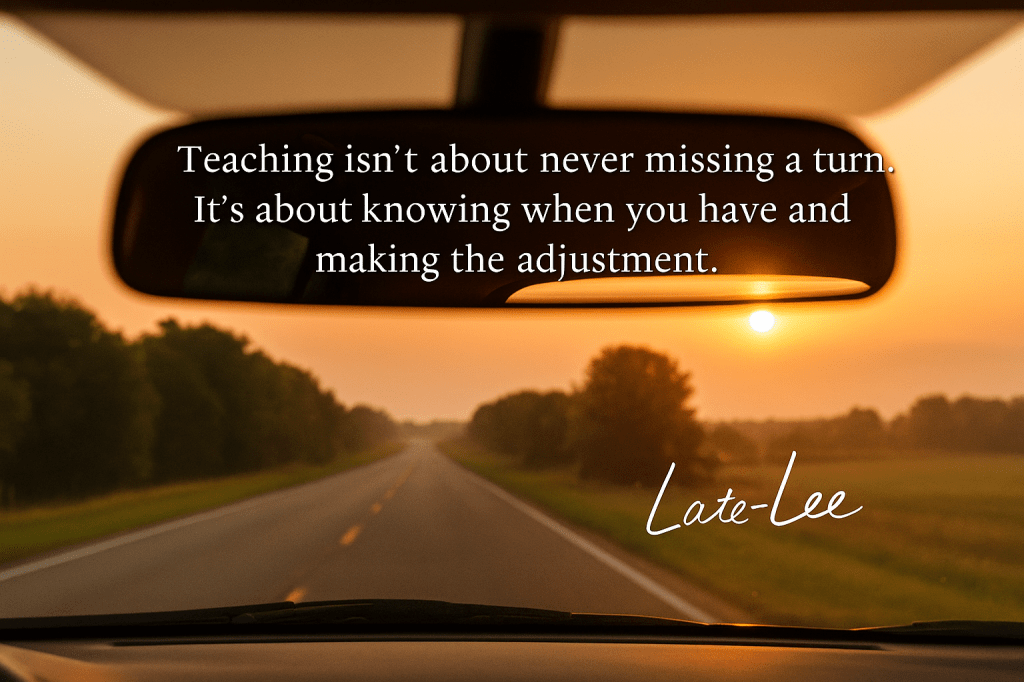
When I finally pull into the location after a long ride, there’s a quiet satisfaction in knowing I made it. I might’ve had to circle the block once or twice, but I got there. Teaching is no different. The road to learning is rarely straight, and the best teachers aren’t the ones who never miss a turn. They’re the ones who notice when they have and make the adjustment.
Formative assessments are what help us do that. They let us see if students truly arrived where the lesson was meant to take them. When we slow down long enough to look at their work, we’re not just checking for completion. We’re checking for understanding, growth, and readiness for what’s next.
So whether you’re recalculating, celebrating, or somewhere in between, remember this: every stop along the way tells you something about the journey. Keep your eyes on the map, your heart in the work, and your hands steady on the wheel. That’s the Late-Lee way to reach your destination: one thoughtful turn at a time.
 Rhonda "Late" Lee
Leave a comment