
 by
by Part 2 of 3: The Learning Journey Series
Haven’t read Part 1? Check it out: Setting the Route – Why Clarity Matters
When we’re clear about what students should know, understand, and do, the next step is knowing whether they’re actually getting there. Too often, we rely on long, end-of-unit tests to tell us who didn’t get it after it’s too late to adjust. However, when done with intention, formative assessment turns our daily lessons into feedback loops for both teacher and student.
Think of it like driving with your GPS on. You don’t wait until the end of the trip to find out you took a wrong turn. You need those real-time updates that reroute you before you end up miles off course. That’s precisely what formative checks do.
During collaborative planning in schools, I often notice something missing. Teams unpack standards, design lessons, and choose activities, but there’s rarely deep discussion about how they’ll check for understanding. The “check” often becomes an afterthought, added in the moment rather than planned with purpose. But without it, we’re guessing instead of knowing.
I remember sitting in a classroom once where a teacher asked her students a question no one could answer. The room went completely silent. After a long pause, she said, “You learned this,” and moved on. Here’s the fallacy in that statement: teaching and learning aren’t the same thing. She may have presented the concept and given students practice, but the quiet at that moment was the data. It was a signal that understanding hadn’t yet taken hold. That silence should have prompted a pause and a reteach, not a dismissal.
When planning formative checks, we allow ourselves to notice those moments and respond. Assessment is what gives standards meaning. It takes the expectation off the page and makes learning visible. A quick exit ticket, sticky-note sort, or one-question reflection can give you far more usable data than a 25-question quiz. The key is alignment. If the learning target says, “I can identify the theme of a story,” then the check should ask students to do precisely that, not summarize, not list details, but identify and explain the theme.
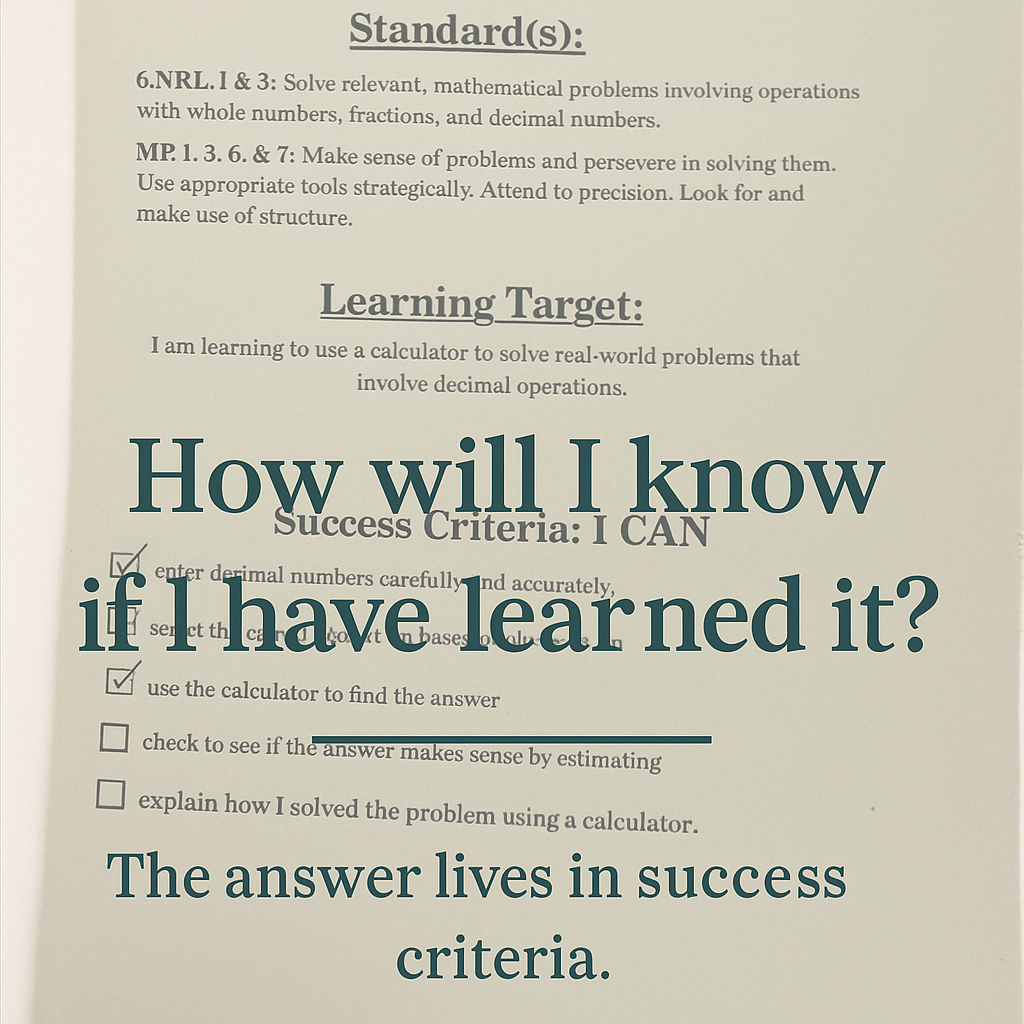
When assessments are designed with the learning target in mind, they do more than measure, they clarify what success looks like. The lesson assessment helps identify the success criteria. Students and teachers use those criteria to gauge where they are in the progression of learning. It becomes a shared roadmap. Teachers see which parts of the target are solid and which need more support. Students gain language to describe their progress: “I can identify the theme, but I still need help explaining how the details support it.” That clarity turns assessment into a learning tool instead of a judgment.
Every student should be able to answer a straightforward question: “How will I know if I have learned it?” Too often, they can’t because the criteria for success haven’t been clearly communicated or modeled. When success criteria are visible and discussed, students can take ownership of their learning instead of waiting to be told whether they “got it.”
It’s interesting that we still struggle to define success in clear, student-friendly terms, even though the concept isn’t new. Success criteria have been part of educational thinking for decades. In fact, Paul Harmon wrote in 1968 that success criteria are necessary for any performance objective associated with student outcomes. Yet, all these years later, many planning conversations still skip this step.
Maybe it’s because we assume it’s implied. Or perhaps it feels easier to talk about activities than outcomes. But when teachers and students know exactly what success looks like, instruction becomes focused, feedback becomes meaningful, and assessment becomes purposeful.
Long, unfocused assessments blur what we’re really trying to see. They mix multiple skills, confuse the data, and make it hard to know what to reteach. In contrast, short, targeted checks help you act fast. They show who’s ready to move on, who needs support, and which part of the lesson needs another pass.
Formative assessments aren’t just for grading; they’re for guiding. When aligned with intention, they don’t just measure learning, they drive it.
Leadership Reflection
When I visit classrooms or sit in planning meetings, do I hear evidence that teachers and students both understand what success looks like?
How often do our assessments serve as a mirror for learning rather than a measure of teaching?
 Rhonda "Late" Lee
Leave a comment